Group Change
Use the Manage tab to add a variance (or change) to multiple employees shifts at the same time. This is a useful time saving feature. Add variances such as a holiday or additional hours to multiple employees in a single action.
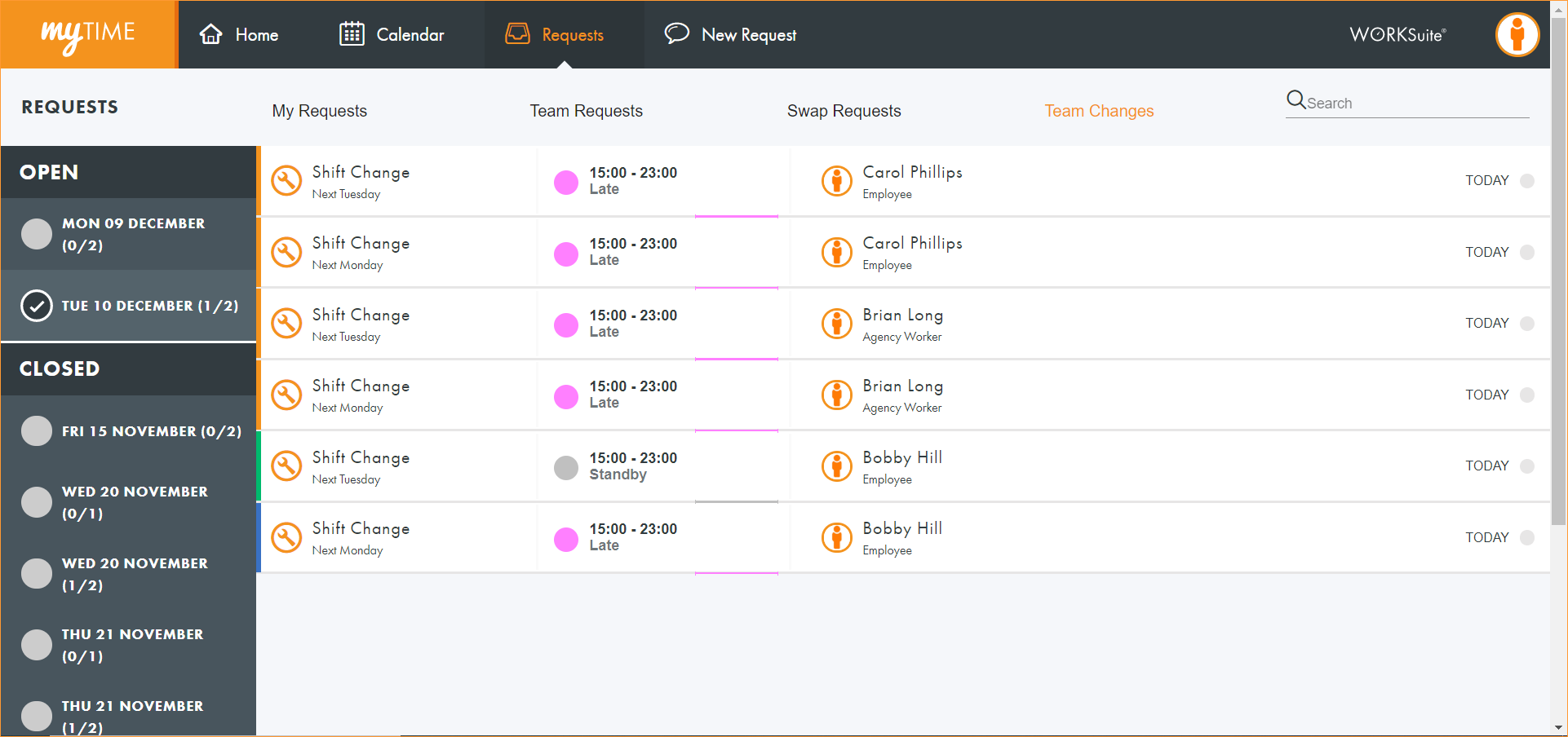
Note: It is possible to add a Bid Request when adding a group change for Shift Change, Additional Hours or Other Events. Select the group of employees who you want to apply the Bid Request to and specify how many of the selected employees you want to fulfil the request. Managers and staff can approve and accept Bid Requests in myTIME. See Shift Change below for an example of how this is displayed in myTIME.
To add a group change:
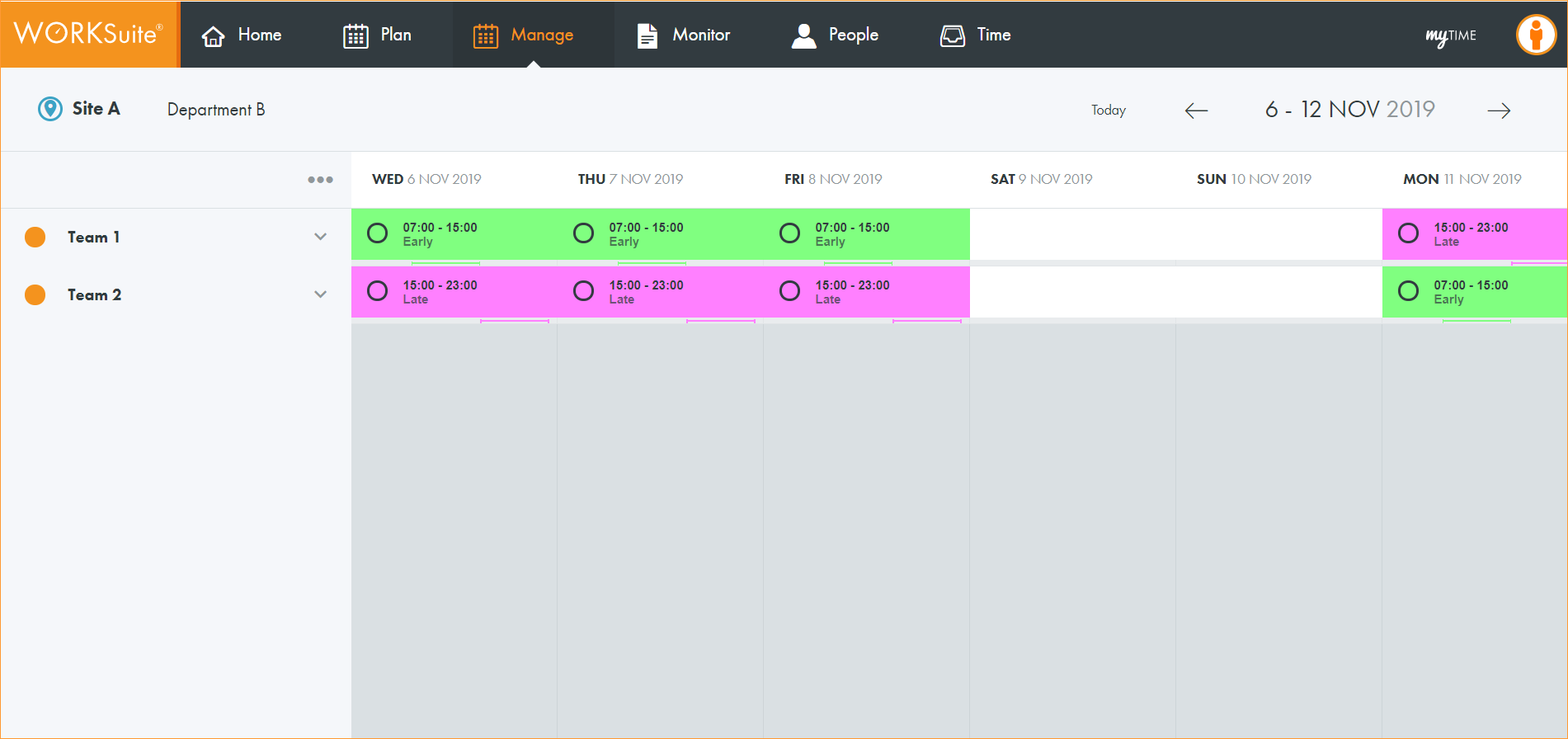
- Open the Manage tab:
- Click
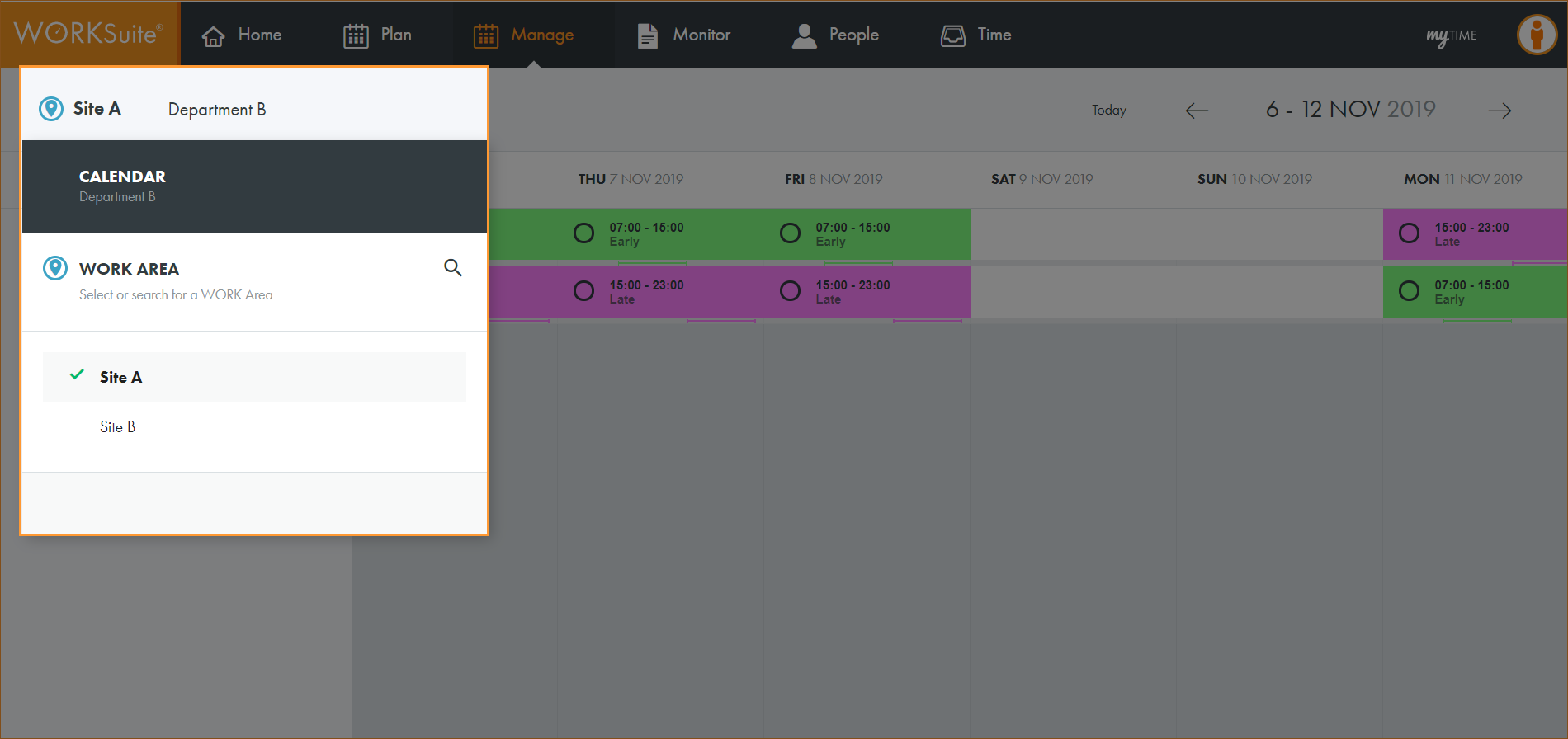
 and select the work area that you want to work with:
 - By default, your previously selected work area is preselected.
- If you only have access to a single calendar, this is pre-selected when the screen loads. There is no need to select a calendar.
- Select the calendar that you want to work with:
- Select Today or use the date navigation tools to select the dates that you want to view:
- Click ... in the top left of the header and select Group Change.
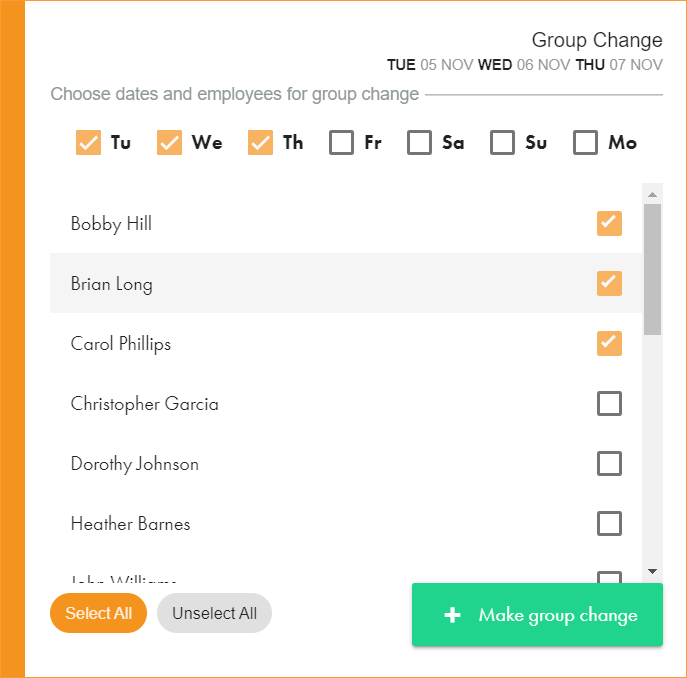
- Use the day checkboxes to select the days that you want to work. These relate to the days that are currently displayed in the Manage screen.
- Use the employee checkboxes to select the employees whose calendars you want to change. Use the Select All or Unselect All if required.
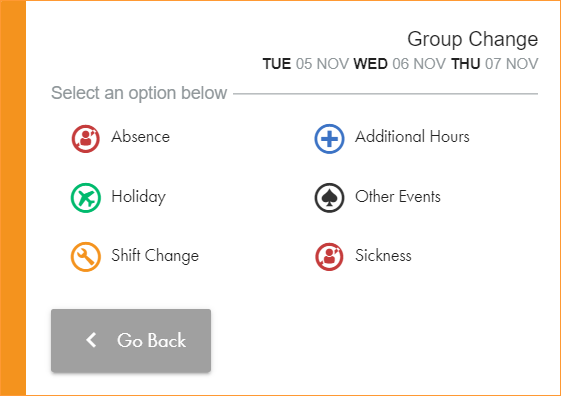
- Click Make group change to display the variance categories. These are preconfigured from six variance types. In this example five variance categories are used ('Shift Swap is not displayed for group changes and 'Absence' and 'Sickness' are dealt with in the same way):
- Select a variance category.
- More detailed variances reasons are listed under variance categories. For example, ‘Authorised’ and 'Unauthorised' absence are listed under ‘Absence’. This is useful for adding detail to a record.
- Each variance category can have a single reason or multiple reasons listed.
- Select a variance reason, if the window is displayed:
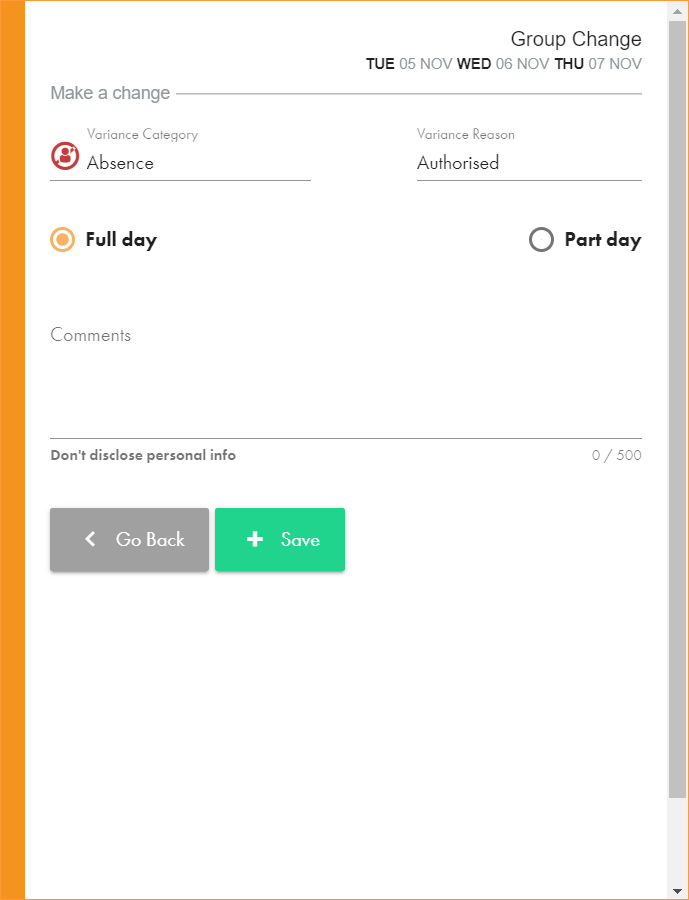
- Complete the variance information screen, this differs depending on the type of variance you are working with:
- Mark the absence as a Full day, Part day or Multi day and adjust the times and dates accordingly:
- Enter any relevant comments. These can be displayed when reporting on variances.
- Click Save.
- Choose to override the warning if changes are being made retrospectively. This allows you to accurately reflect the actual working time for employees.
- Refresh the page.
- Mark the leave as a Full day, Part day or Multi day and adjust the times and dates accordingly:
- Enter any relevant comments. These can be displayed when reporting on variances.
- Click Save.
- Choose to override the warning if changes are being made retrospectively. This allows you to accurately reflect the actual working time for employees.
- Refresh the page.
- Select the shift that you want to change to:
- Set the shift change as a Bid Request, if required.
- If using Bid Request, enter the number of Heads required. This enables the number of employees required to be tracked against the number of employees who choose to accept the bid. Managers can track the bid request under Team Changes in myTIME:
- Once saved bid requests are listed for employees under My Changes in myTIME.
- All employees who are eligible for the request are notified and can choose to accept or decline the request.
- Employee calendars are only updated once a bid has been accepted in myTIME by an employee and subsequently approved by a manager.
- Scroll down the window and enter any relevant comments. These can be displayed when reporting on variances.
- Click Save at the bottom of the window.
- Choose to override the warning if changes are being made retrospectively. This allows you to accurately reflect the actual working time for employees, regardless of WTR breaches.
- Refresh the page.
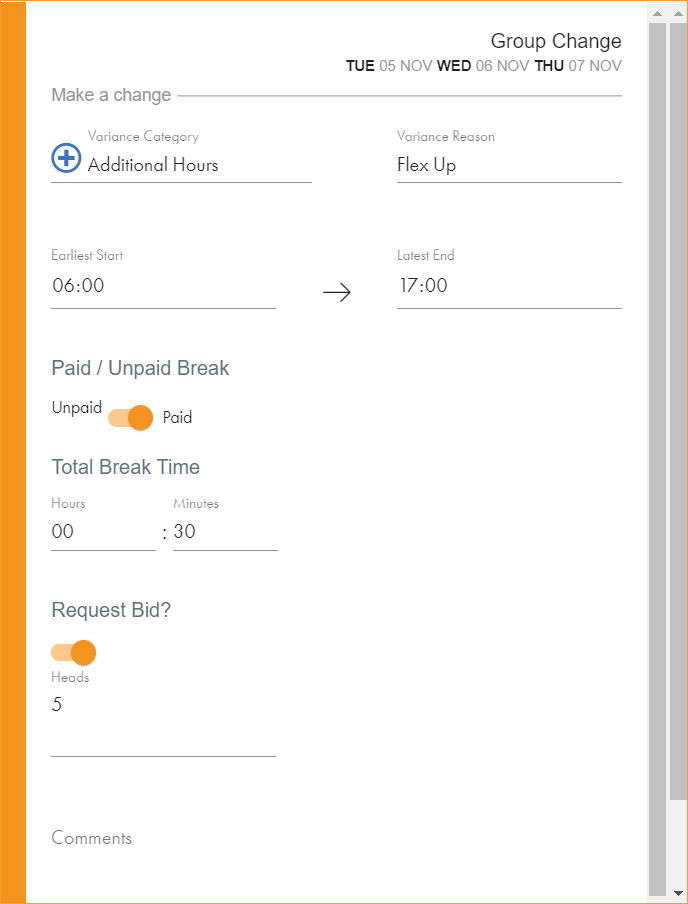
- Select whether the additional hours are to be worked Before or After the Main Shift (this is not displayed if you are adding additional hours to a rest day) and enter the number of additional hours/minutes to be worked:
- Mark whether the additional time qualifies to have a Paid or Unpaid Break and enter the total hours/minutes for the break.
- Set the additional hours as a Bid Request, if required.
- If using Bid Request, enter the number of Heads required. This enables the number of employees required to be tracked against the number of employees who choose to accept the bid. Managers can track the bid request under Team Changes in myTIME.
- Once saved bid requests are listed for employees under My Changes in myTIME.
- All employees who are eligible for the request are notified and can chose to accept or decline the request.
- Employee calendars are only updated once a bid has been accepted in myTIME by an employee and approved by a manager.
- Scroll down the window and enter any relevant comments. These can be displayed when reporting on variances.
- Click Save.
- Choose to override the warning if changes are being made retrospectively. This allows you to accurately reflect the actual working time for employees.
- Refresh the page.
- Mark the event as a Full day, Part day or Multi day and adjust the times and dates accordingly:
- Set the event as a Bid Request, if required.
- If using Bid Request, enter the number of Heads required. This enables the number of employees required to be tracked against the number of employees who choose to accept the bid. Managers can track the bid request under Team Changes in myTIME.
- Once saved bid requests are listed for employees under My Changes in myTIME.
- All employees who are eligible for the request are notified and can chose to accept or decline the request.
- Employee calendars are only updated once a bid has been accepted in myTIME by an employee and approved by a manager.
- Scroll down the window and enter any relevant comments. These can be displayed when reporting on variances.
- Click Save.
- Refresh the page.
- The variance is displayed on the shift and the employee’s account is updated.
Note:
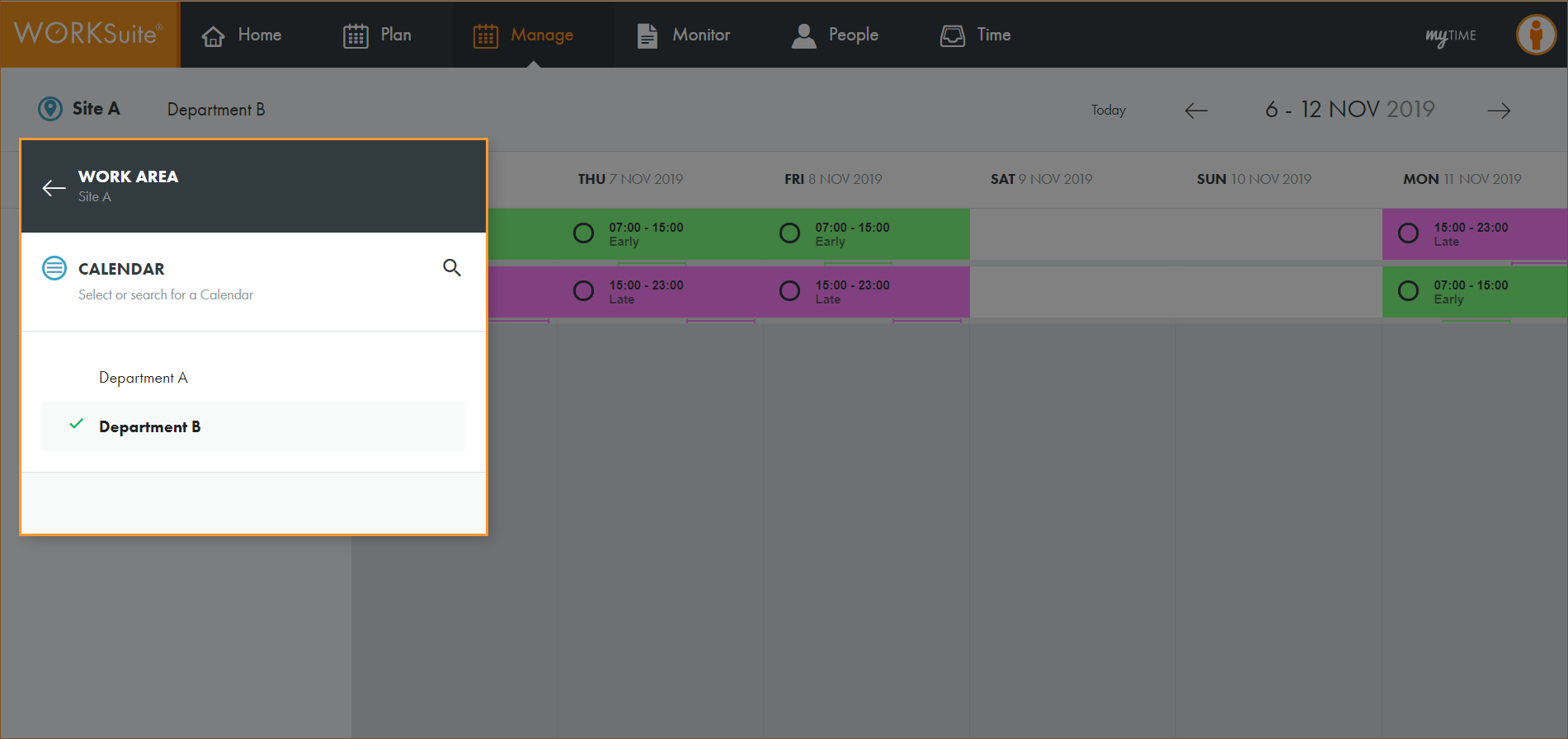
Note: By default, your previously selected calendar is preselected.
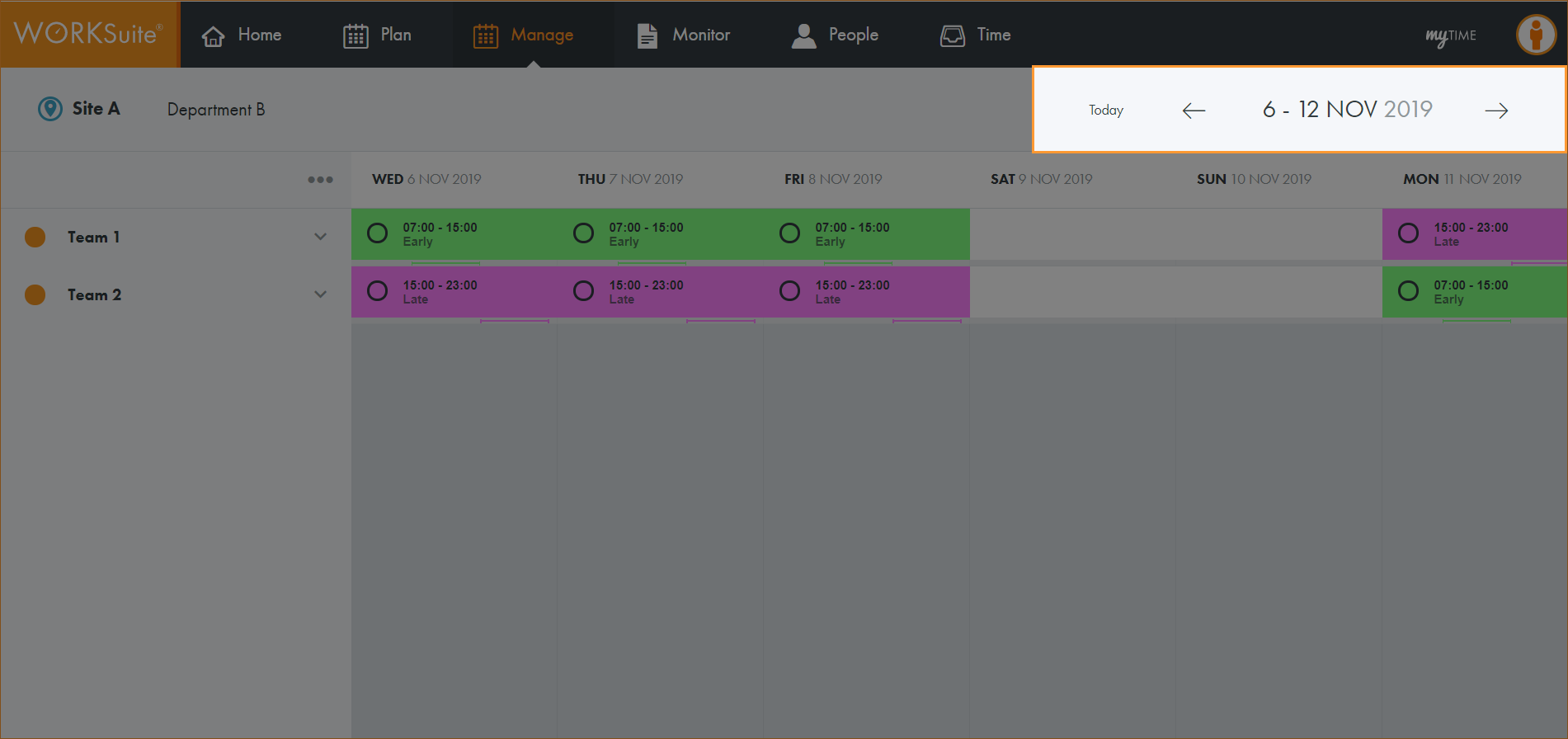
Note: You cannot navigate to a new week until the information for the week which is currently shown is fully loaded. The navigation buttons are temporarily disabled to prevent multiple weeks being loaded at the same time.
All teams published in the selected calendar are listed.
A popup window is displayed:
Note:
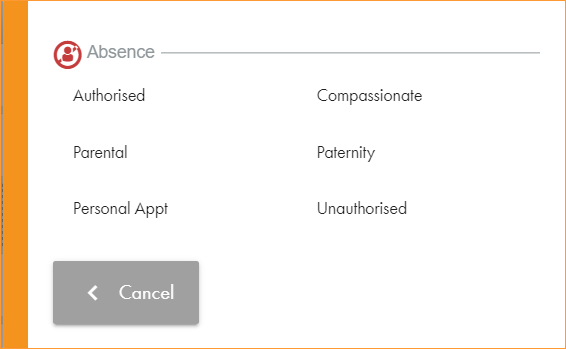
Note: Where there is only a single variance reason for a category this window is not displayed. You are taken straight to the variance information screen.
 Absence.
A clash warning is displayed if the variance clashes with any existing variances listed for the selected employees:

If employees have a full day of absence, their shifts are highlighted grey to reinforce their non-availability status.
 Holiday.
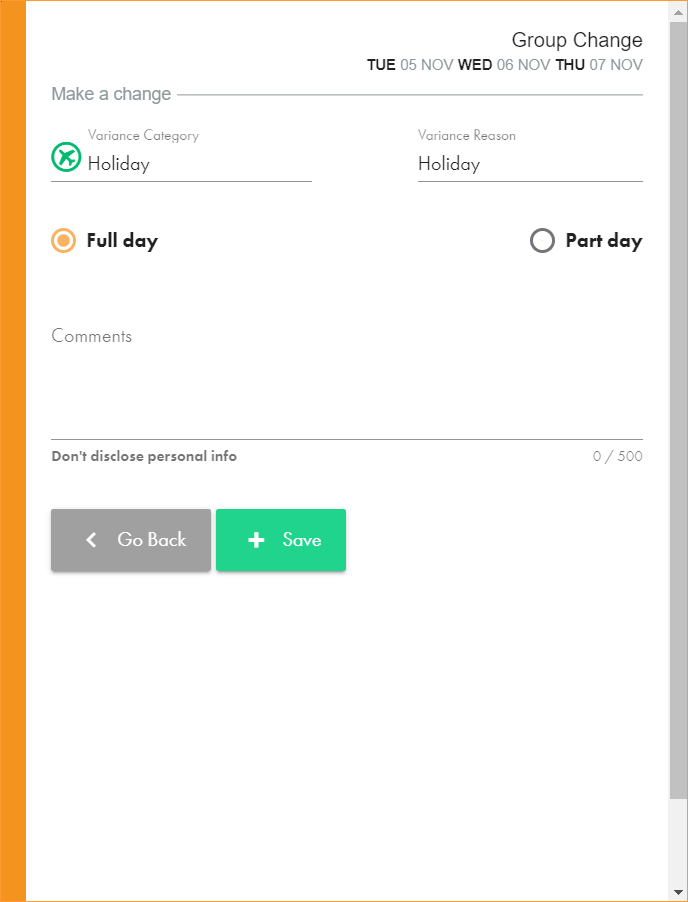
A clash warning is displayed if the variance clashes with any existing variances listed for the selected employees:
If employees have a full day of holiday, their shifts are highlighted grey to reinforce their non-availability status.
 Shift Change.
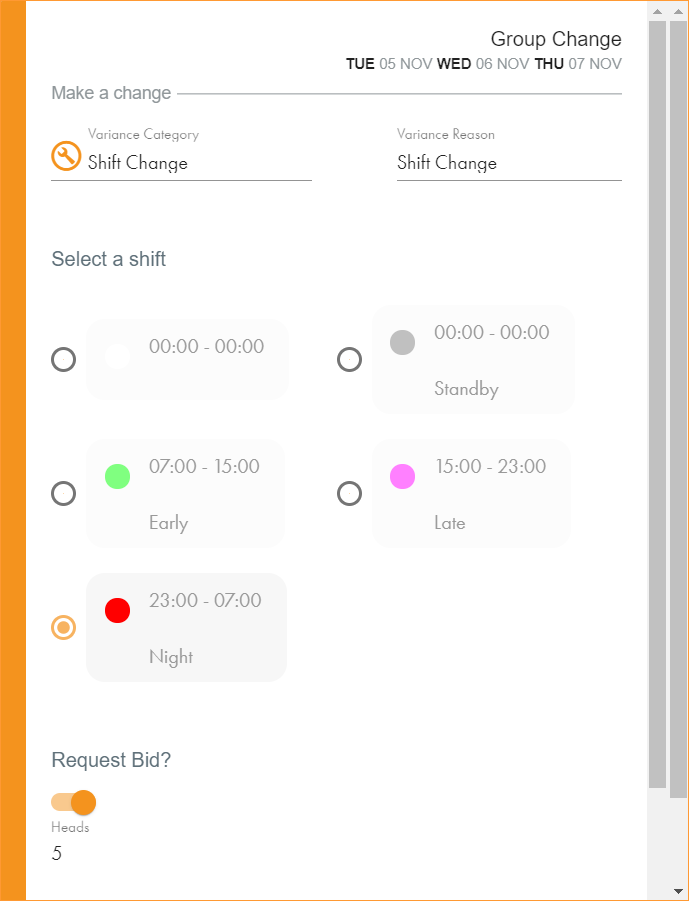
A Working Time Regulations warning is displayed if the variance is in breach of the Minimum Rest Between Attendance rule (11 hours) for any of the selected employees:
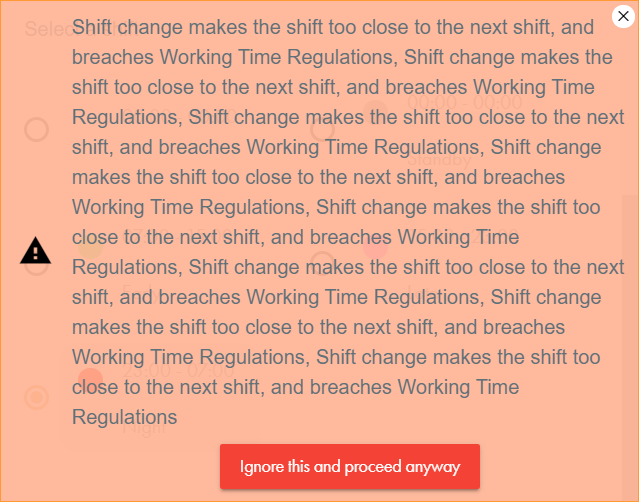
The alert is displayed if the start of the shift on the next day is less than 11 hours from the end of the new shift. The start time is adjusted for any holiday or absence which is set to begin at the start of the shift on the next day. The start time used will be the end of the holiday or absence, when the employee is expected to work.
 Additional Hours.
Additional hours can be added for an employee on a current working day or a rest day. Using this process is useful when employees work non standard shifts on their rest days; reporting on worked hours is simplified.
A clash warning is displayed if the variance clashes with any existing variances listed for the selected employees:
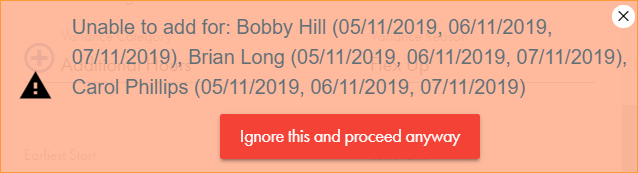
A Working Time Regulations warning is displayed if the variance is in breach of the Minimum Rest Between Attendance rule (11 hours) for any of the selected employees.
The alert is displayed if the start of the shift on the next day is less than 11 hours from the end of the additional hours. The start time is adjusted for any holiday or absence which is set to begin at the start of the shift on the next day. The start time used will be the end of the holiday or absence, when the employee is expected to work
 Other Events.
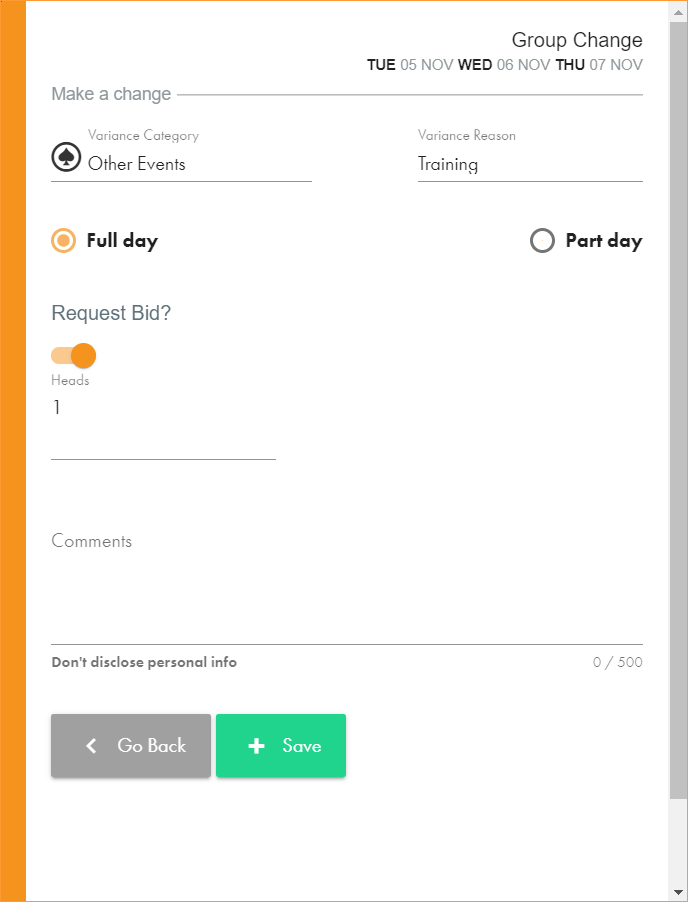
If employees have a full day event, their shifts are highlighted grey to reinforce their non-availability status.